As early as 1901, the German psychologist Karl Groos discovered that infants express extraordinary happiness when they first figure out they can cause predictable effects in the world, pretty much regardless of what that effect is or whether it could be construed as having any benefit to them. Let’s say they discover that they can move a pencil by randomly moving their arms. Then they realise they can achieve the same effect by moving in the same pattern again. Expressions of utter joy ensue. Groos coined the phrase “the pleasure at being the cause,” suggesting that it is the basis for play, which he saw as the exercise of powers simply for the sake of exercising them.
David Graeber, Bullshit Jobs
Twenty four hours into The Legend of Zelda: Tears of the Kingdom, I found myself thinking about how good it feels to have the world register your existence. It happened after I’d spent half an hour scrabbling higher and higher up a series of floating islands just for the fun of it. There had been similar moments during the first game, of course, afternoons where a glowing light in the distance or an unusual mountain top had prompted a seemingly foolish trek into the unknown. These moments are practically the sales pitch for modern Zelda games: all the pleasures of wild climbing without the possibility of leg-fucked death, or even of being badly affected by the rain.
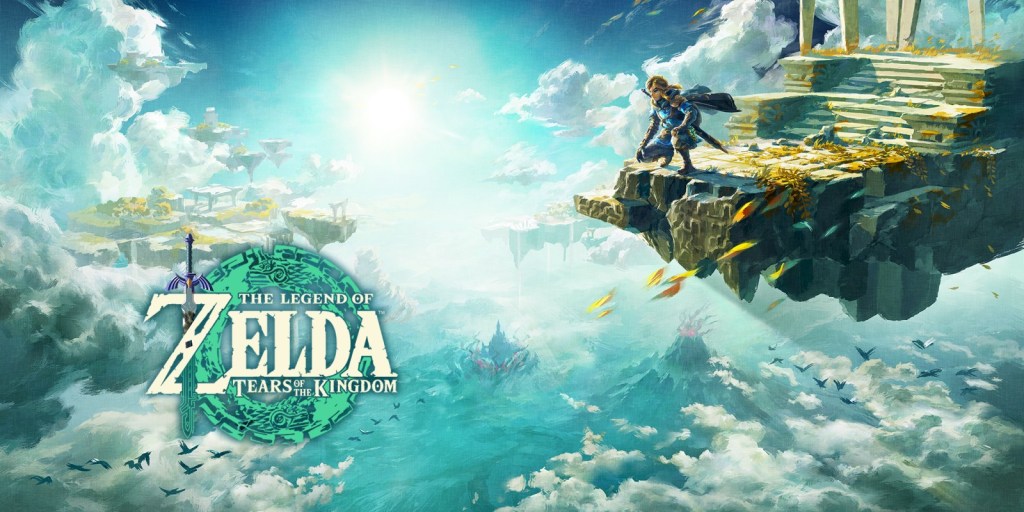
There are times where the sheer beauty of the world Nintendo have built for us fails to hide the fact that its storytelling lacks the finesse of any random sky jump. The way the light hits the hills and valleys of these imaginary kingdoms, the movement of clouds over the water, the way the sun casts new light over strange ruins – all of this makes you want to speak of the films of Hayao Miyazaki. Plot and theme do what they can to further this comparison, but when you consider the execution you realise that Miyazaki’s elemental fluidity has taken on a more plastic feel in this interpretation. Some of this is down to exposition that lacks poetry, and some of it comes through in the more generic elements – the endless dynastic inheritance of the side-characters, for example, or the need to portray the requirements of the franchise as some sort of eternal story cycle.
More crucially, there is an absence of consequence to our adventures in Hyrule. Both Miyazaki’s movies and the recent Zelda games capture the thrill of acting on the world, but only one of them conveys the sense of failure and horror that can come of it in a way that is anchored to our collective responsibility.
To worry about this too much would show a lack of generosity. Tears of the Kingdom builds on what came before with an eye towards expanding the player’s sense of freedom. Its new tricks – the ability to build daft contraptions out of passing scraps, the fresh landscapes under the earth and in the sky – do what needs to be done to hold off the occasional sense that we are perhaps too happy to be moving a pencil back and forth.
I played the first of these games in lockdown like everyone else. I’m playing the second while working to train out a leg injury that makes it hard to get to the local shops. The thrill of being able to act in the world has eased the frustration of these times. Still, I wouldn’t go as far as William Lennon did in The Paris Review:
The game designer Shigeru Miyamoto… has cited Paul Cézanne as a major influence, describing the graphics in his work as “moving paintings.”
Within this aesthetic frame, however, the action is less modernist impressionism and more a postmodern Fluxus, where actions are equally deconstructive and constructive, and activities that have conventional artistic correlates are designed to be toyed with, experimented on, and used for brazen (or impish) ends. The player can practice sculpture and engineering (building machines with “Zonai devices”), photography (an optional part of the game involves taking pictures of every item and creature with a smartphone-like device), and dance (combat mechanics that pay homage to the “bullet-time” sequences of The Matrix)… Tears of the Kingdom isn’t an escape from reality but an advertisement for reality—including the aesthetic practices that already make our own.
The Cézanne influence is worth noting, and is a welcome expansion of our vision, but it’s the mention of dance that’s the real giveaway. Fighting in Tears of the Kingdom doesn’t look much like dancing. More crucially, it doesn’t feel like it. There is no sense of a dance partner here, or of anyone observing you. There’s no intelligence to spar with, just a set of established moves to counter with as much ingenuity as you bring to bear on the moment. When scrapping with the cute creatures and creepy puddles of Hyrule, I am completely aware that it’s just me and the screen. This is an advertisement for reality, but not in the way described above – where much of the game satisfies my pleasure at being the cause, these moments reignite my longing to be acted on by the world.
 Blue Box // Recorder
One response to “Losing the stars without a sky – Tears of the Kingdom”
[…] yesterday’s post about Tears of the Kingdom set me off on the hunt for articles about the game. In-between reviews and strategy guides, the […]
LikeLike