The first in a series of posts about Six Feet Under
Re-watching Six Feet Under, the temptation creeps in to make it a story about Nate Fisher’s hair. It’s fun to watch the first season, with its eruptions from the afterlife and the subconscious, and to marvel at how our man always looks like he’s about to go drum for Sum 41.
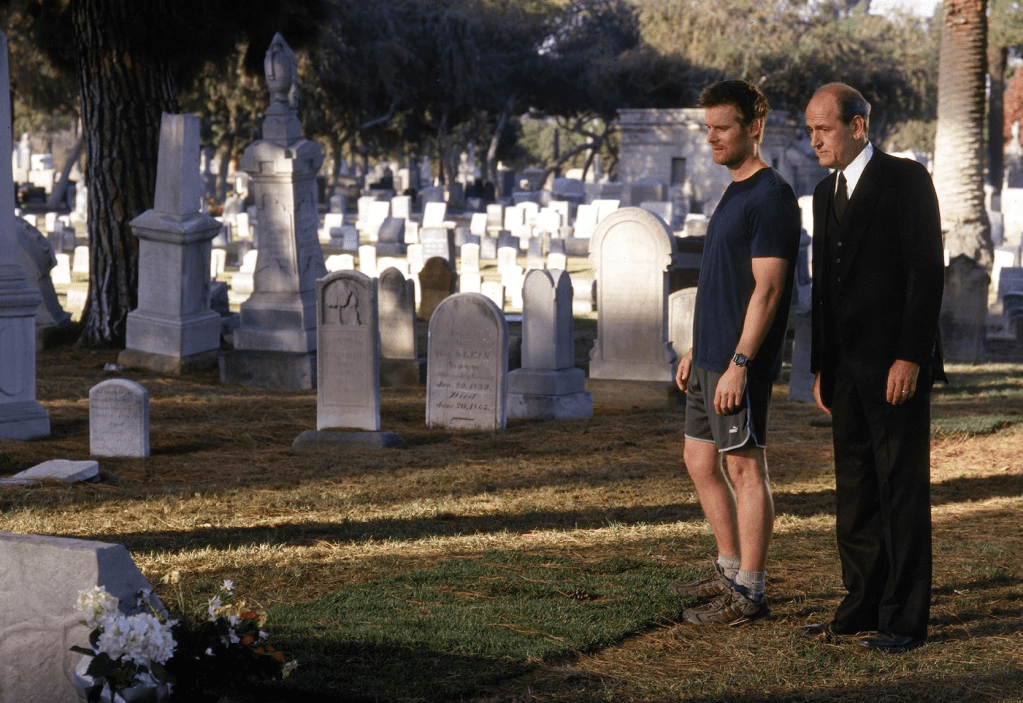
Then you have the visions of bald Nate (alive/dead/still here/never there) that follow season two’s surgical cliff-hanger. Refreshing as it is to visit a multiverse without a marketing department, Nate’s shaved head serves a classical purpose: underneath the flash smiles and neuroses, we’re all skeletons. While this little memento mori might seem trite, it undoubtedly has a better claim on being a universal truth than the persistence of Batman.
Before and after that, we see the effects of gravity pulling that hair down into a fringe. This is middle class adulthood, the knowledge that everything is sinking into the dirt, but also that you are looking more respectable every day you remain above ground. As for the scar under the mop, that reminder of all the universes where Nate didn’t make it? It doesn’t matter if no one sees it, we all start to feel that itch on our scalps eventually.
Visible or otherwise, that nagging feeling is built in.
***
Early on in the series, a freshly-bereaved Ruth Fisher finds herself experimenting with ‘The Plan’. This self-help cult works its grift through endless building metaphors: blueprints, foundations, renovation.
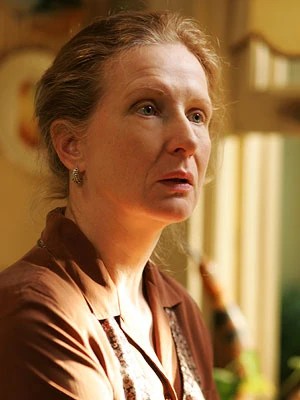
It’s a gimmick so aggravating that Ruth sickens on it within a few episodes. Looking back over the series as a whole, this framework starts to appeal. The way the show stacks up its bodies strikes me as being meaningful, perhaps even more meaningful than Nate’s hair. Whether we’re in the kitchen or the morgue, the art class or the afterlife, the room is always set up to show us how the distance between these people is expanding or contracting at any given moment.
Despite Alan Ball’s plastic bag Buddhist credentials, and the characters’ tendency to speak their truths, Six Feet Under is built on solid foundations. It’s a show about shared plumbing between different parts of existence, a show that knows that someone’s life blood can bubble up through the sink without warning. It’s portrait of growing pains experienced by conservative gay men, the children of bohemia, and bereaved matriarchs. In the end, it’s stronger for the way it shows all of these struggles happening under the same roof.
***
Also solid: the cast, which branches through the screen culture of its era and on into the new one. Across five seasons, the Fisher home hosts a regular parade of great actors, including: Michael C. Hall (Dexter), Lauren Ambrose (Yellowjackets), Ed Bagley Jr. (Best in Show), Kathy Bates (Misery), Rainn Wilson (The Office), Mena Suvari (American Pie), Richard Jenkins (Burn After Reading), James Cromwell (Babe), Justin Theroux (Mulholland Drive) and Michelle Trachtenberg (Buffy).
Compared to some of its peers, the appeal of Six Feet Under can be hard to pin down. It doesn’t have the meathead appeal of The Sopranos, or its inheritance from ’90s indie cinema. Where Deadwood and The Wire introduced new grammar to TV, the rhythms of Six Feet Under were more familiar.
If you wanted to make a case for why Six Feet Under was still worth watching, you could start with the way it makes time for all of the actors listed above and more without ever boxing them in.
 Blue Box // Recorder
3 responses to “Six Feet, Infinite Dimensions”
[…] its soap-opera structure, where characters move around a problem rather than plodding through it. At the risk of repeating myself, there’s a sense of finitude to its movements, an awareness of how much space these […]
LikeLike
[…] Six Feet, Infinite Dimensions […]
LikeLike
[…] Six Feet, Infinite Dimensions […]
LikeLike