
A few people have suggested that I start up a ScotLit video channel recently. I’ve resisted the temptation so far, but sometimes wonder if this is me trying not to talk to avoid hearing my own thoughts. I always saw myself as the type of weegie that dreams of being elsewhere – Gotham City, New York, Tokyo… basically anywhere but London, right? – and yet here I am writing about Freakslaw and Hermit and Luda and Poor Things. Time to buy a light rig, mebbe set the make-up gun to “dazzle”? Naw, let’s keep our thoughts about Kirsten Innes’ Scabby Queen purely textual for now.
The last time I wrote about this book I mentioned how it “depicts a world I recognise, one I grew up into and now understand to have passed.” A risk here of treating the book as popular history, an area where Kirsten Innes has some experience, but no. If this were the story of a failed or successful revolution, that might be the mode. As things stand, we never got that far, and Scabby Queen takes a distinctly novelistic approach to both the past and the possibility of social change. “Novelist in novelistic approach shockah!” I know, but sometimes it’s good to consider the dimensions of the thing as they are.
(There’s a danger here, a temptation to claim that novelistic lives are lives without the potential to be something else. The form is perfect for making the complexities of bourgeois existence comprehensible, but the tensions of that existence belie the idea that such conditions are eternal. I now feel a perverse desire to go further, and to suggest that true social change is only possible if we recognise each other as novelistic subjects, but that feels sentimental and self-limiting. There are always other forms, other ways “to see oursels as ithers see us”; another form is always possible, as is another self, another Scotland.)

Anyway, Scabby Queen is novel as collage, a portrait of fictional pop star cum activist Clio Campbell that starts with her death and works to put the pieces together like an Alan Moore or Orson Welles classic, jumping from era-to-era and viewpoint-to-viewpoint in pursuit of a multifaceted truth. Beyond mere coincidences of time and geography, the articulations of Campbell’s involvement in social movements have the familiarity of a tired photograph smile.
“This was important stuff they were doing, she thought, in their own little corner” is too small, too earnest, but I felt the line and its warm whisky afterburn. There are hints of bile before and after the line itself, but the fire’s still fresh in your mind seven years and sixteen pages later, when half a lifetime’s disappointment gets spat out over a pint:
“I lost it up there. I’m – ach, Neil, I dont see what the point is sometimes. I mean, back in the day, when we were taking direct action – our protests counted for something. You know? We could form a human shield around a house. We could show up in our hundreds of thousands to George Square or mob the buses down to London and feel like we were making a difference. We got the fucking poll tax binned! That, today. I just didn’t feel like there was any energy. And why would there be? Nobody cared about what we did there. It was just a group of people getting together to murmur their displeasure. Ach. Ach ach ach. When did protest become a hobby for rich people? Did you see some of those fuckers out there? I mean, it’s like mass gatherings have become marketable or something.
I quote this not because it’s an inarguable truth, but for what it fails to hide. The way believing in a better world can work your guts over the years. How the triumph of the other side can make your old victories seem like crumbling photographs. How your own failure to turn your part into a steady gig as an MSP or pop star or pundit – and perhaps, on a deeper level, your understanding of your own scunnered spirit – will have you shooting daggers at the ones who did figure out how to cash in.
The novel’s portrayal of Campbell excels beyond these boundaries, of course. I recognised the character type in myself and others, for all its brilliance and its flightiness. The intensity of the glare, what it might seek to hide. The occasional retreats back into a Scottish state of mind that is, for all its big talk, unable to tolerate the idea of anyone reaching beyond the most carefully enforced boundaries. This is also, undeniably, a novel of how all of this looks when the big personality involved is a woman. The chapters that deal with the SpyCop plot have a sense of agitation to them that is unmatched elsewhere in the book; the arguments between people who were victims of this plot are carefully shaded, each perspective given the empathy it’s due; the chorus of sexist press coverage seems a but loud and obvious at first but gains its truth through endless repetition.
When I first invoked Alan Moore in relation to Scabby Queen, in another post, I’ll admit that I was thinking about Watchmen. Back then I hadn’t got far enough into the book to realise it contained its own masterplan, revealed when it’s too late for anyone to try and stop the author of this great work.
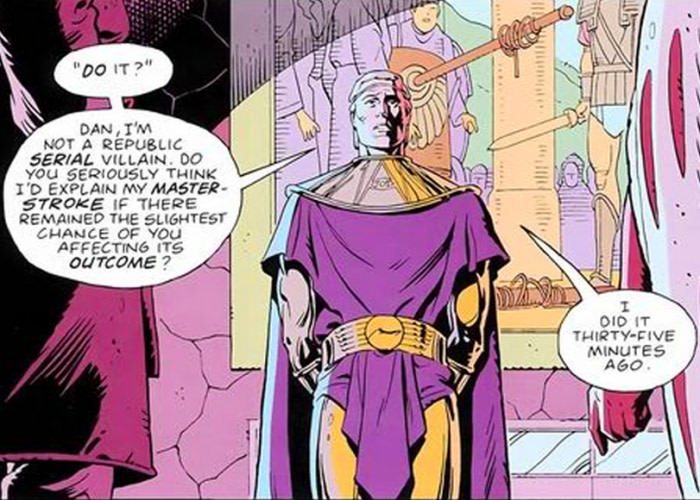
I’ve seen some criticism of this aspect of the novel elsewhere, with Catherine Taylor in the Guardian stating that “a posthumous credo at the novel’s end fails to convince.” This takes us back to Scabby Queen’s defiantly novelistic aspect. The big plan may be more or less flawed than the one that ends Watchmen; the question of whether it is convincing is one that plays out in the story itself, to be considered by those who might want a better world, or a better history, and those who are perhaps happier to have something new to sneer at or sell.
***
“For the epic, the world at any given moment is an ultimate principle; it is empirical at its deepest, most decisive, all-determining transcendental base; it can sometimes accelerate the rhythm of life, can carry something that was hidden or neglected to a Utopian end which was always immanent within it, but it can never, while remaining epic, transcend the breadth and depth, the rounded, sensual, richly ordered nature of life as historically given. Any attempt at a properly Utopian epic must fail because it is bound, subjectively or objectively, to transcend the empirical and spill over into the lyrical or dramatic; and such overlapping can never be fruitful for the epic.”
György Lukács, The Theory of the Novel
 Blue Box // Recorder