The fourth in a series of posts about Six Feet Under
Previously:
- Six Feet, Infinite Dimensions
- “I made a terrible decision and brought us to a horrible place“
- Comic Book Men
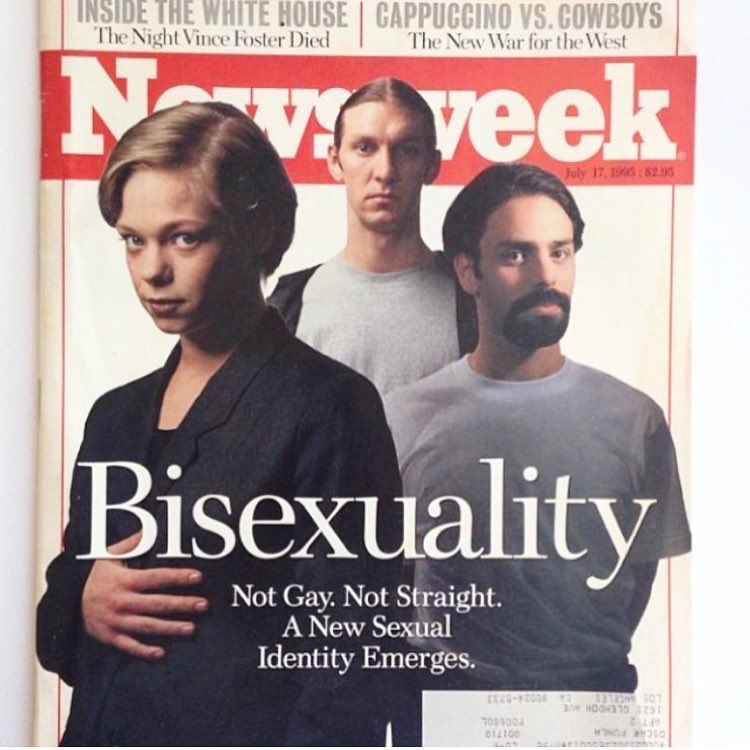
Meanwhile, in the mid ’90s:
In my last post on this subject, I made a passing reference to Six Feet Under being weird about bisexuality. This is a theme that really flares up in the third season, when Claire goes to art school and becomes involved with Russell, her gay friend who turns out to be straight until he fucks a male teacher while he and Claire are seeing each other. It escalates further in the fourth season, when Claire attempts a fling with another classmate, performance artist Edie (Mena Suvari).
This plot line prompted my previous comment about the show’s weirdness about bisexuality. The jump between Claire and Edie attempting to fuck and Edie complaining to her peers about Claire’s homophobia feels abrupt. Plausible – maybe Claire was more overtly “grossed out by her pussy” off camera, or maybe rejection just hurts; either way, we may feel differently about these situations after the fact – but in dramatic term it plays out like a part of the story is missing.
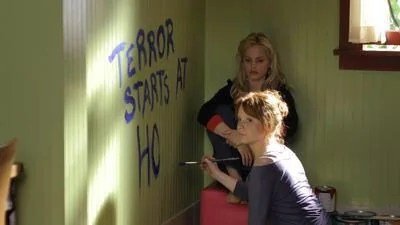
Edie’s dejection makes more sense when Claire makes a late insensitive attempt to make out with her on the dance floor. Up until that point, this twist feels like it’s connected river of deeper feeling that runs through the show as a whole. It’s a power body of worry in the show. At some points it threatens to sweep stray side plots up in its currents.
I figured that if a woman couldn’t get me off, I couldn’t possibly be bi. Today I recognise that this logic had many fallacies – for one, orgasms dont define sexual attraction; for two, I’d never let a lackluster encounter with a man convince we that I wasn’t straight (including the guy who couldn’t cum unless Bourne Identity was on). I’d self-inflicted a double standard and had expected my first hookup with a woman to somehow “prove” my queerness to myself.
Jen Winston – Greedy: Notes From a Bisexual Who Wants Too Much
Off the top of my head, here are all the Six Feet Under characters it’s implied have had sex across the gender spectrum:
- David – Slept with women while he was younger, but this is unambiguously presented as an attempt to fit in with social norms. Doesn’t express any enthusiasm or curiosity about the idea in the present tense. Actively panics when Keith (his partner) fucks a woman.
- Keith – Like David, Keith fucked women in the past. Unlike David, we’re told that he loved it. When he sleeps with pop star Celeste in season 4 while working as her bodyguard, David seems more freaked out by the gender gap than the age gap or HR issues.
- Russell – Says he’s not gay at one point, then goes on to be maybe the only character to call themselves “bi” for even a minute. Sleeps with Claire and Olivier, blows Jimmy, and has intense feelings all over the shop. When David expresses an arch skepticism about his dalliances with women, you get the feeling the show agrees.
- Olivier – “Is he having a boy year?” someone asks early on. Sleeps with Russell (his pupil), having apparently fucked Billy (a former student) in the past. Ends up in a relationship with Billy’s mother Margaret for the last half of the show (oh those Chenowiths!).
- Billy – Slept with Olivier when he was younger, says it helped him work through something but that it was “A sex thing, not a gay thing.” Who among us has not said this at one point, regardless of whether it makes any sense? Sexually harasses his sister and also Claire, then spends a good season or so dating the latter.
- Claire – Was clear that she hadn’t been attracted to women before hooking up with Edie, but gave it a shot. Acted entitled to more from Edie after the latter expressed her rage at Claire’s ambivalence. We never see her make an approach on a girl after that. She’s with Billy for a while, then with Christian rock enthusiast/Republican lawyer Ted, maybe the most heterosexual character on the show.
- Jimmy – Gives Claire her first orgasm. At the very least, Russell gives him a blowjob at one point.
- Javier – Worked with Keith on his private security gig with Celeste. Bangs on about banging women a lot, then bangs on about banging Keith when he clocks that he’s gay.
Six Feet Under is a show with a lot of characters we could call bisexual, or bi-curious, or pansexual, or a lot of other things if we were so minded. I’m conscious here of not wanting to insist that people – even fictional people – go along with the label I’m most comfortable with for the sake of neatness. The important point is that if we look at raw numbers, there’s representation here. Sexuality that’s varied in its nature, and acted upon during the actual runtime of the show, give or take the odd dramatic omission. We come not to bury Six Feet Under then, but to raise the question of perspective.
What does it mean that so many people in this series fuck across genders? Or that so few of them are comfortable with this fact?
Replications of the 2015 YouGov survey were conducted in Germany, Israel and the US. In all three, at least a third of young people identified as neither exclusively homosexual nor exclusively heterosexual, landing them somewhere on the bisexual spectrum. In all three, young people were far more likely than older people to fall on the bi spectrum and to explicitly identify as bisexual. And, in all three, some of the people who placed themselves on a sexual spectrum denied that such a spectrum exists.
Julia Shaw – Bi: The hidden culture, history and science of bisexuality
I’ve noted above that David seems to view Russell’s bisexuality as little more than an ill-fitting disguise, something he’ll discard when he’s grown into an adult gay. For all that he takes more joy in sex with women than his partner, Keith seems to agree. Hell, maybe they’re correct – but maybe not, right? Their amused condescension is rooted in a shared experience that while not without complication – see: Keith x Celeste – is still broadly harmonious. For these characters, a mixture of personal history (fucking women to fit in) and dating history (hooking up with men who then decided it was “just a phase”) has lead to an understanding of how sexuality works that excludes other possibilities. Or perceives them as unreliable, at best.
The show broadcasts this attitude too, sometimes in the things characters say, and sometimes in the way its deeper currents dictate story development. There’s nothing to be gained from dwelling on the Claire/Edie plot in any more detail, I think. But it’s worth considering how Olivier is portrayed as a manipulative liar. Or how Russell’s story develops into a horny farce as it goes. Six Feet Under is a product of a time and certain worldview, and yet, despite all of this, it’s a show rich with characters who don’t entirely fit with that framework.
Like the survey results Julia Shaw mentions in the excerpt above, the discord is both aggravating and ultimately quite telling.
 Blue Box // Recorder