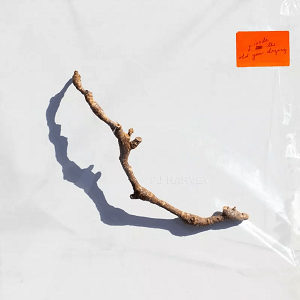
A hard album to describe if not to listen to, I Inside the Old Year Dying has sent music writers scrabbling for the press release. Three details recur in reviews: that field recordings are part of the soundscape, that Harvey asked John Parish and Flood to stop her from using “the PJ Harvey voice”, and that the album has its roots in her poetry collection Orlam. These are fine starting points, but unlike the album itself they don’t take us anywhere.
Claire Biddles gave an uncommonly perceptive account of the forces at work in her review for The Wire:
The song titles are a puzzle of repeated words and variations of phrases, like a secret language in plain sight. All over the album are sounds that can’t easily be identified, or that sit in between recognisable timbres. This results in a kind of hyperreality that seems to relate to the album’s title – the sense of remaining still in a place that is rotting and changing, or perhaps remaining alive in an impossible time.
The motion of these songs is circular, with muted guitar, drums, and vocal chants spiralling round and round on a seasonal theme: “Hail the hedge as it grows/Ask the hedge all it knows”. Anytime you feel too certain about what you’re listening to, something breaks through to disturb your sense of time and place. When the focus on seasons and landscape starts to sound pre-modern, in comes a reference to Elvis or “Pepsi fizz”. When your brain goes for the word “witchy”, in comes a quote from John 13:34. When you’re wondering whether this is a folk album, in comes the warped, electric rattle of ‘The Nether Edge’ or the glitchy ambience of ‘All Souls’.
These flourishes are matched by Harvey’s vocals, which refuse an easy characterisation or point of view: are they ghostlike or earthen? are they haunted or knowing? do they speak to a sense of innocence or experience?Harvey’s NPR interview might prove more illuminating than the press pack here, focusing as it does on the ambiguities of the dialect she speak-sings across the record.
One of the keys that opened up this world for me was the Dorset dialect. As a poet, it gave me such another lively form to work with, because it gave the words a kind of double meaning. For instance, you’re pulling the word “wordle” out. Although it means “world” in Dorset dialect, you’ve also got “word” in there — and, of course, the word of God. It carries such an enormous capacity for wrapping everything together.
What to make then of “Wyman”, which means “King” but sounds like it might refer to a queen? What of the “femboys in the forest“, or the “not-girl zwealed at the stake“? Where do we locate the Nether/Never-edge and Nether/Never-Eden in this story? And do we think that when “She knew herself a vessel/Fit for a different wordle“ she meant another word to describe her, another world to live in, or another god to speak for? There is great stillness to the form of these songs, an understanding of the cyclical nature of things. There is also something else, something that communicates the changes that are always happening, here and elsewhen – summer into autumn, youth into adulthood, life into death, old self into someone else.
Picking three favourite songs from a record as beguiling and hermetic as this isn’t easy, but while I recommend listening to the whole thing on repeat these are the tracks that standout for me:
After a sing-song, almost a cappella intro, the electric guitars and backing vocals of ‘Seen an I’ represent one of the two points where I Inside the Old Year Dying comes close to rock’n’roll. The guitar pattern is similar to the ones found throughout the album, but there’s something to the way the hand drags its way back and forth that speaks to a memory of the Rolling Stones. The verses of ‘The Nether-edge’, meanwhile, exist free of all such embodied concerns – if you told me that the music was simply playing itself, I might just believe you. Harvey’s high pitched, rangy vocals on the chorus are all purpose though, a clear attempt to communicate across some sort of unfathomable divide.
‘A Child’s Question, July’ is the album’s most potent and ritualistic song. The mentions of a “Horny Devil/Goaty God” blur in with the steadily picked guitar lines and slow thudding percussion to give the suggestion of fire and dancing, until you realise that all the sounds are folding back in on themselves, the view kaleidoscoping into something else entirely.
 Blue Box // Recorder