
(Harmony Korine, 2009)
When I was living and doing political activism outside of Glasgow, I spent a little time at community council meetings in areas that were either rural or suburban. The priorities in these meetings were often new to me, and I tried to take even the frustrating parts as a learning experience.
There was one community council I sat on that had an obsession with a man who would cycle around the area at night. This was raised with the police over and over. Eventually the group had to be politely asked to give it up: the guy wasn’t robbing, he wasn’t fleeing scenes of violence, he wasn’t part of an underground pizza delivery ring. As far as anyone could tell, he had never caused any harm. He was just a guy who really liked to cycle, at night, when the roads were clear.
At the time I was annoyed and faintly amused by this saga. I wanted them to leave the guy alone, not have the cops question him. After seeing this film I wonder if I might have been wrong about the night cyclist. I wonder if he was a trash humper.

Korine talks about this film as both an attempt to create a cursed “found” item and as a portrait of the American landscape. I don’t know enough about the back alleys and street lights of America to say what sort of pish he’s talking this time, but I do know what it’s like to walk around through areas where a lot of people live, but not that close together. Stumbling around the suburbs when the sun’s gone down, you find yourself in an environment that casts you as a villain rather than a passer by. The lack of natural oversight from other humans, the abundance of space blocked off from the passing walker, the inescapable sense that more care has been given to letting cars pass through than humans – all of this adds up. Add in lights that jab out of great blocks of darkness as if in accusation and a few “Neighbourhood Watch” stickers and you might just find yourself wondering – what are these people looking out for? is it me? and if so, are they right to?
If you gave into that impulse, and allowed yourself to become a villain in search of some torchlight, you might just become a trash humper. I suspect you’d draw some fellow wanderers to you just with your cackling, and that you’d soon be letting the side down and giving no fucks in the process.
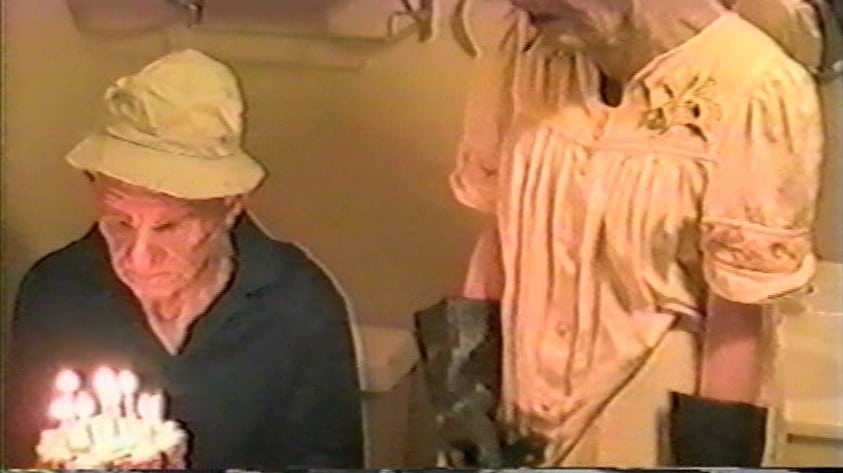
As a found footage film, Trash Humpers extends this sense of unprompted foolishness into its every formal aspect. At points its stuttering mantras (“Make it, make it, don’t break it”), its mix of childish antics and hellish old faces, and its juxtaposition of banal depravities with spontaneous tap dance sessions will have you dreaming of the traditional cinematic virtues of the Jackass movies. At the same time, there’s something affecting about it once you settle into the grain of the cracked, implicitly nostalgic VHS aesthetic – a longing to fuck around without finding out that feels true to the environments glimpsed beyond all the shaking and shrieking on screen.
 Blue Box // Recorder